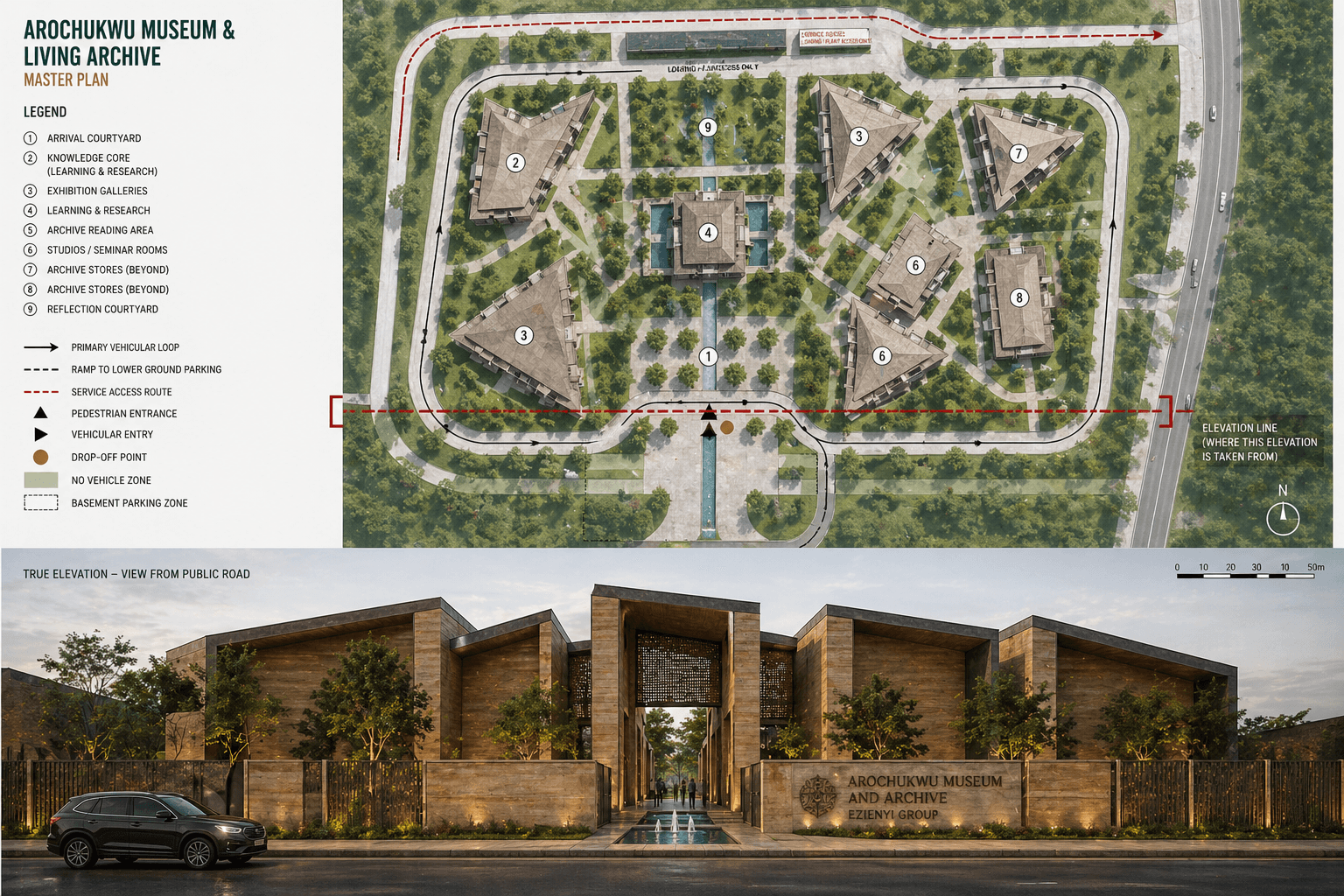
"DAA is not a school. It is a seed. A system. A sanctuary. A shared future rooted in justice."
FOUNDING ETHOS — DESIGN ASSOCIATES AFRICADesign Associates Africa is a Pan-African, community-rooted platform reimagining design, architecture and education. Founded to dismantle colonial frameworks and build culturally embedded alternatives — through campuses, curricula, communities and partnerships that centre justice, spatial intelligence and African futures.
All courses are stackable, supporting lifelong, flexible education. Every campus, programme and partnership is designed to be additive — building a living ecosystem rather than a fixed institution.
The architecture
of a different
education.
DAA is not built on a curriculum. It is built on a worldview. Three intellectual foundations structure every decision — from programme design to campus ecology to how a critique is held.
— Paulo Freire
Education is not the deposit of knowledge into passive minds — it is the transformation of consciousness through dialogue, questioning, and the collective naming of the world. DAA does not teach students about Africa; it invites them to read Africa as living text, to name its contradictions and imagine its futures. The educator and the student are both transformed by the encounter.
— Carol Dweck
Capacity is not fixed at birth. It is cultivated through challenge, iteration, and a culture that treats failure as data rather than verdict. DAA's studio culture is built on the understanding that intelligence expands — and that the most rigorous environment is not one that avoids difficulty, but one that makes difficulty meaningful and iteration honourable.
— Continental Epistemology
The continent's communities hold spatially intelligent, ecologically sophisticated, and culturally rich bodies of knowledge that formal institutions have systematically excluded. DAA treats these not as supplementary material but as primary epistemological foundations — from which design, architecture, agroecology, and spatial justice are understood, not translated.
DAA Charity
Values, Curriculum & Stewardship
DAA Ltd
Studios, Enterprise & Innovation
DAA Nigeria
Manages Local Implementation
DAA Education & Platform
Pathways, Standards, Access & Credit Mobility
DAA US Branch
Advocacy, Global Alliances & Diaspora Partnerships
Unit DAA
Research, AI & InnovationInvestigating the future of artificial intelligence, professional practice and the built environment.
The research and innovation division of Design Associates Africa — bringing together architecture, technology, education and industry to study how AI can enhance professional capability, lifelong learning and decision-making across the built environment.
EXPLORE RESEARCHFHEQ-aligned
curriculum from
EY to PhD.
Every programme is stackable, accreditation-mapped and designed to support lifelong, flexible education across Africa and the diaspora.
Six principles
of the studio.
A disposition, not a method. How DAA makes knowledge, holds uncertainty, and builds the conditions for genuine learning.
Critique as Care
Feedback is not judgment — it is attention. DAA critiques are structured around the question: what is this work trying to become? The critic's role is to listen before speaking, and to name what the work knows before naming what it lacks.
Iteration as Intelligence
Returning to a problem is not failure — it is sophistication. The design process is understood as spiral, not linear. Each revision deepens understanding. Each discarded version contains knowledge the next iteration inherits.
Site as Teacher
The community, landscape, and history of a place contain knowledge unavailable in any library. DAA requires all research to begin on site — with listening, walking, mapping, and silence before the first drawing is made.
Dialogue as Method
Learning happens in the space between people, not within them alone. Freire's dialogical method is embedded in every studio session: the educator and the student are both transformed by the encounter.
Making as Thinking
The hand thinks. The drawing speaks. The model argues. DAA treats the act of making — in clay, in timber, on paper, in code — as a legitimate form of intellectual inquiry, not merely illustration or presentation.
Uncertainty as Competence
Not knowing the answer is not ignorance — it is the beginning of research. DAA cultivates epistemic humility: the ability to hold complexity, ask better questions, and design from within uncertainty rather than despite it.
Each study originates on site, shaped by memory, community and spatial circumstance.
Cultural Infrastructure
Museums, archives, community learning environments and civic spaces rooted in place and memory.
Freire's conscientization: spaces where communities name, claim, and begin to transform their world.
Housing Research
Compound typologies, courtyard systems and regenerative density models for African cities.
Ubuntu spatial intelligence: the compound as a model of collective dignity, mutual care, and shared life.
Material Intelligence
Climate-responsive materials, rammed earth, bio-based construction and technical knowledge networks.
Indigenous knowledge recovered: earth, clay, timber, and lime as legitimate architectural science.
Spatial Governance
Education, mentorship, professional development and institutional frameworks across Africa.
Dweck's growth model institutionalised: pathways that expand with the learner rather than close around them.
Eight institutional partners across the UK, Nigeria, South Africa, Ghana and the United States — supporting accreditation, mentorship and collaborative research.
The future of
AI and the built
environment.
Unit DAA is the research and innovation division of Design Associates Africa.
It brings together architecture, technology, education and industry to investigate how artificial intelligence can strengthen professional capability, support lifelong learning and improve decision-making across the built environment.
Rather than developing technology for its own sake, we ask how emerging tools can help professionals learn, collaborate and make better decisions — keeping people, ethics and societal impact at the centre of the work.
AI & Professional Practice
Investigating how artificial intelligence augments professional judgement rather than replacing it — keeping expertise, ethics and accountability at the centre.
Future Learning
Exploring lifelong professional capability: how practitioners continue to learn, adapt and grow across the whole arc of a career.
Human–AI Collaboration
Studying how people and intelligent systems work together across the design, construction and operation of the built environment.
Research Infrastructure
Developing the methods, tools and frameworks future professions will need to research and evaluate emerging technologies responsibly.
An open
research journal.
Unit DAA publishes Research Notes — short, public writings exploring emerging questions around AI, professional education and the future of the built environment. They form an open research journal: a way to think out loud, share early findings and invite dialogue.
View Research NotesGhana Rural Futures Programme
Regenerative Educational Infrastructure BriefsIn DevelopmentA collection of village-scale educational and agricultural infrastructure proposals developed in collaboration with local communities in the Volta Region of Ghana. Rather than importing generic school models, the proposals explore climate-responsive architecture, regenerative agriculture, local material systems, multigenerational learning and cultural continuity. Each village is treated as a unique spatial ecosystem with its own agricultural identity, educational needs, environmental strategy and cultural narrative.
Volta Region — Ghana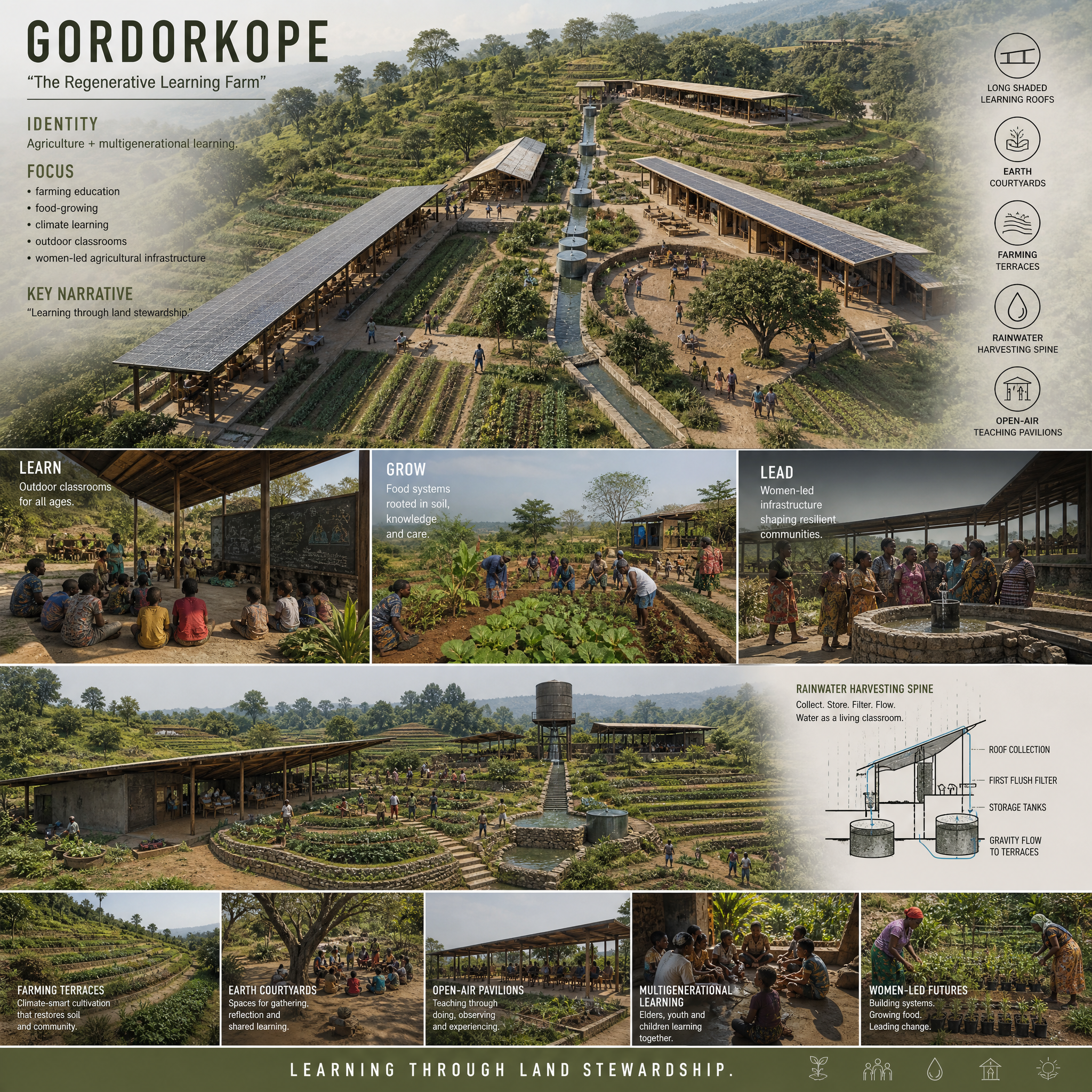
Gordorkope
The Regenerative Learning FarmEnvisioned as a regenerative learning campus where education and agriculture become inseparable. The proposal transforms temporary learning infrastructure into a village-scale educational farm environment supporting food-growing, climate education, outdoor learning, women-led agricultural knowledge and intergenerational teaching. The campus becomes both a school and a living agricultural ecosystem.
"Learning through land stewardship."
PEDAGOGICAL LENSFreirean generative theme: the farm as curriculum. Learning is not preparation for productive life — it is productive life, made conscious.
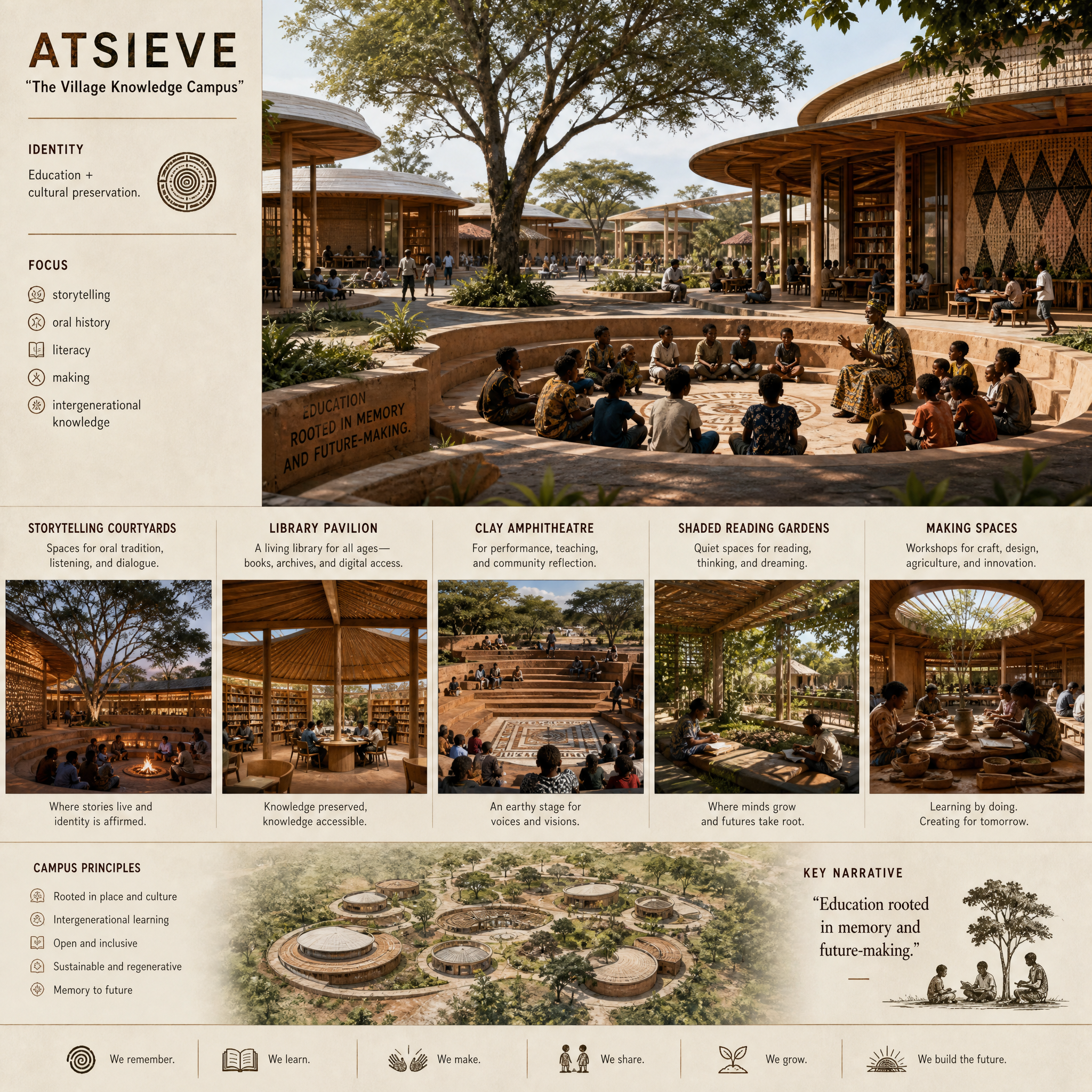
Atsieve
The Village Knowledge CampusA cultural learning campus centred around storytelling, literacy and community knowledge exchange. The project explores architecture as memory infrastructure, educational space, oral archive and community gathering system — integrating reading gardens, storytelling courtyards, shaded library pavilions and communal amphitheatres.
"Education rooted in memory and future-making."
PEDAGOGICAL LENSMemory as legitimate epistemology. The oral archive and the storytelling courtyard are scholarly spaces — as rigorous and generative as any library.
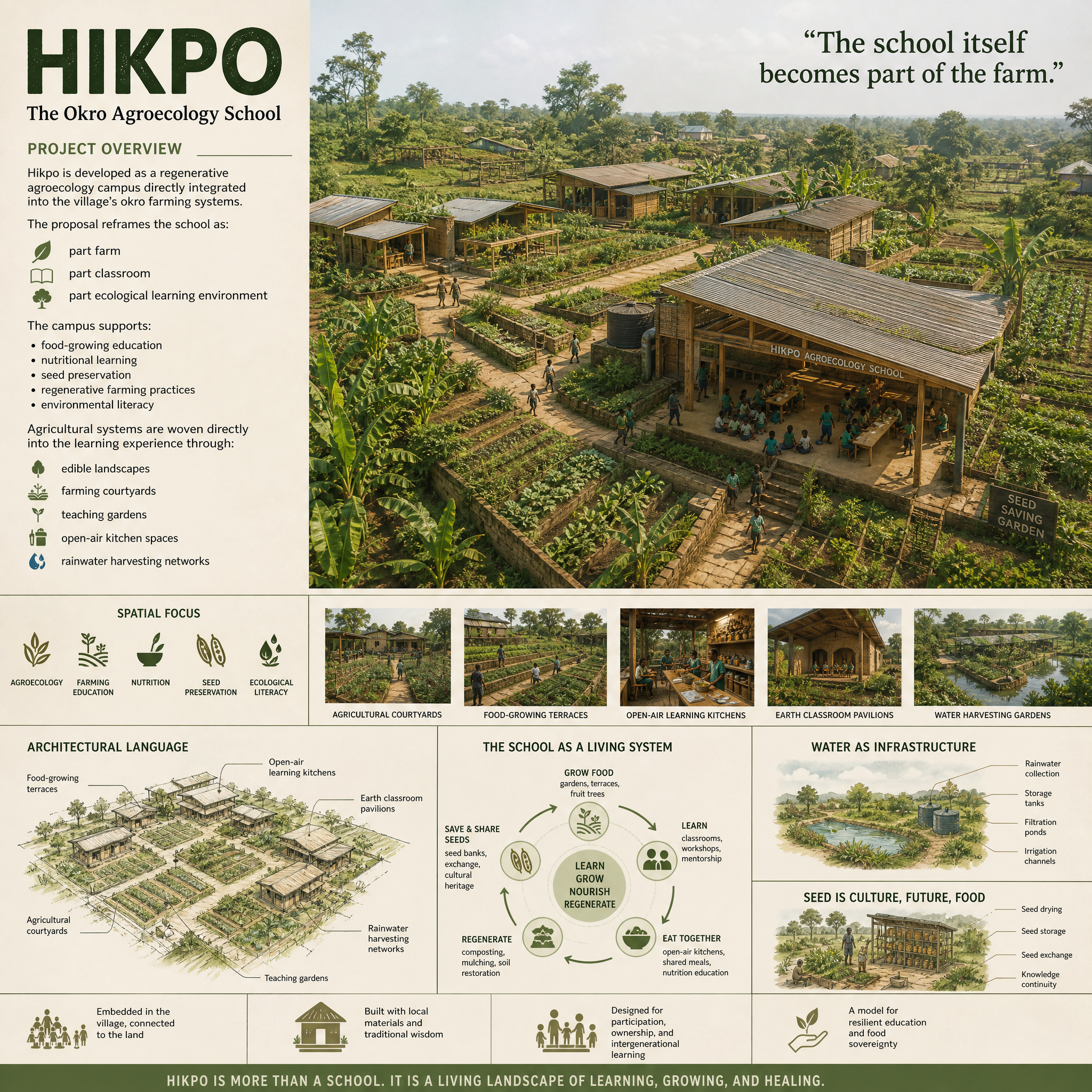
Hikpo
The Okro Agroecology SchoolA regenerative agroecology campus directly integrated into the village's okro farming systems. The proposal reframes the school as part farm, part classroom, part ecological learning environment — weaving agricultural systems into the learning experience through edible landscapes, farming courtyards, teaching gardens, open-air kitchen spaces and rainwater harvesting networks.
"The school itself becomes part of the farm."
PEDAGOGICAL LENSParticipatory ecological literacy. The body is the first instrument of environmental understanding — knowledge is grown here before it is written.
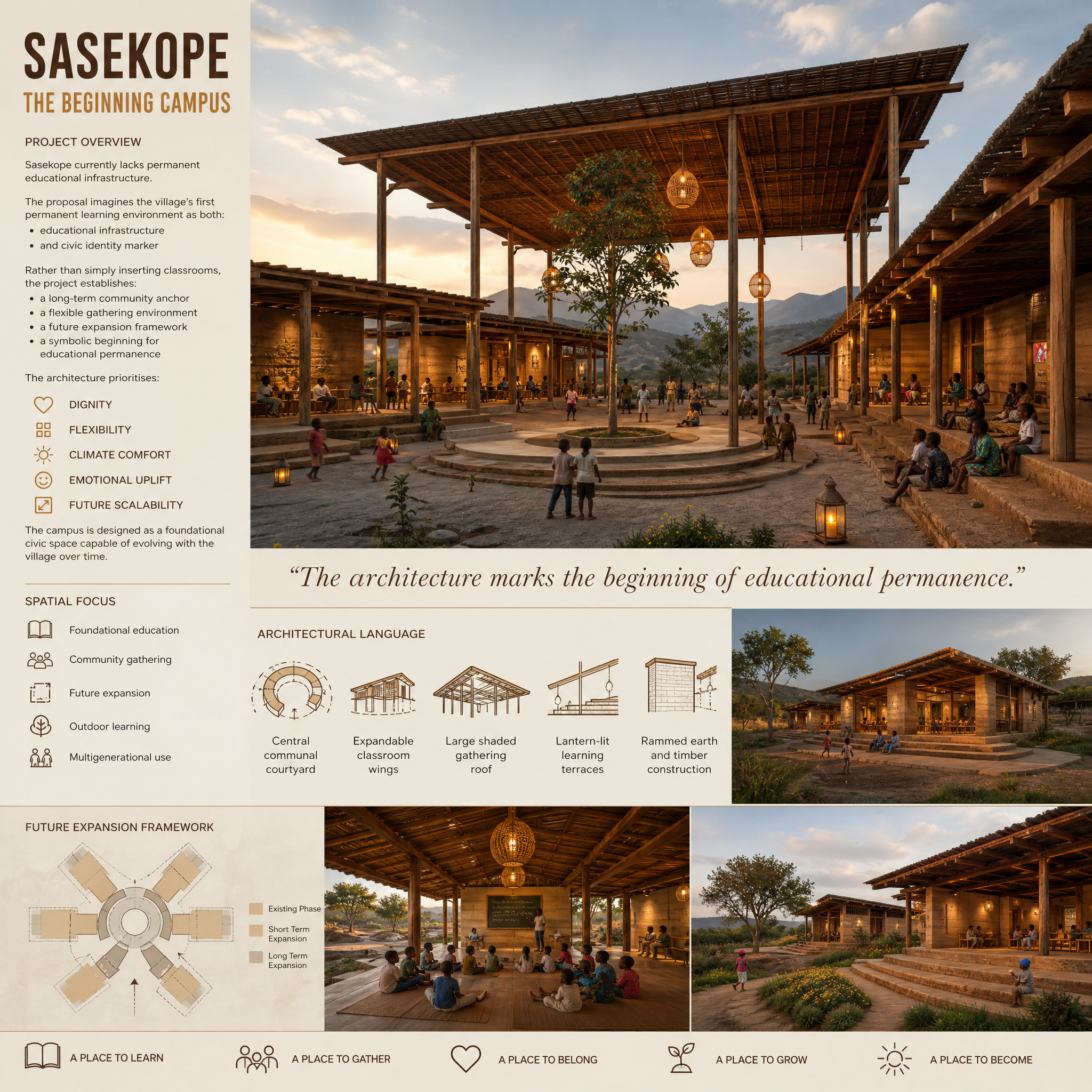
Sasekope
The Beginning CampusCurrently lacking permanent educational infrastructure, Sasekope's proposal imagines the village's first permanent learning environment as both educational infrastructure and civic identity marker — establishing a long-term community anchor, a flexible gathering environment, a future expansion framework and a symbolic beginning for educational permanence.
"The architecture marks the beginning of educational permanence."
PEDAGOGICAL LENSDweck's growth principle made spatial: the first permanent school declares that in this place, capacity is not fixed — it is expandable, and the architecture is its proof.
Materials Holodeck
In DevelopmentA digital material intelligence platform exploring regenerative construction systems, climate-responsive materials and technical knowledge infrastructure across African and UK contexts — bridging traditional and emergent building knowledge.
London, UKAgroecology & Landscape Systems
Research PhaseResearch into how architecture and landscape can integrate food systems, ecological thinking and community infrastructure — farmworker studios, food-growing zones, herbal clinics — into spatially resolved and regenerative environments.
West AfricaStatus
updates.
Current state of active research threads and programme milestones. Updated as the work progresses.
Champion
DAA's mission.
From governance and stewardship to global partnerships and community equity — there are multiple ways to get involved and advance the DAA ecosystem.
You can help us cover the 3% platform processing fee when donating — every penny makes a difference.
DAA is a practice-led research and education unit within Studio RDN-X. Work is developed through collaboration with institutions, researchers and communities across Africa and the diaspora.
Architect, cultural strategist and researcher. Working across architecture, interior design and spatial research with a focus on African built environments, cultural infrastructure and regenerative design systems.
A network of qualified architects providing mentorship, accreditation support and professional development pathways for emerging African designers and architects.
We work with architects, researchers, community organisations and cultural institutions on a project-by-project basis. Collaboration enquiries welcome.
African knowledge
systems are not
supplementary.
They are primary. The intellectual act of decolonisation that DAA performs is not rhetorical — it is structural, designed into the curriculum, the campus, and the critique.
The compound is not an adaptation of the house — it is an original architectural intelligence. Agroecology is not traditional farming — it is a sophisticated systems science. Oral tradition is not the absence of writing — it is a different, and often richer, epistemic form.
DAA's curriculum does not treat African knowledge systems as subjects to be studied. They are foundations from which to design — the bedrock beneath every programme, every campus, every research commission. This is what decolonising design actually looks like: not a module, but a methodology.
Spatial Intelligence
The compound, the courtyard, the threshold, the gathering circle — African spatial forms carry embedded social, ecological, and cosmological intelligence that pre-dates and exceeds contemporary architectural theory.
Ecological Knowledge
Indigenous land management, agroforestry, water harvesting, and seasonal reading of landscape — practices refined over millennia that constitute a sophisticated ecological science, not simply tradition.
Oral & Embodied Knowledge
Knowledge held in story, song, ritual, craft, and the body — transmitted across generations through participation rather than inscription. DAA treats these as legitimate research methodologies, not folklore.
"DAA isn't just a curriculum or a platform — it's a living ecosystem rooted in justice, cultural integrity, and design excellence."
Collaborate,
research or build
with DAA.
We welcome collaborations with institutions, researchers, designers and communities working across Africa and the diaspora.
hello@rdn-x.com@designassociatesafricaPolicy reference available on request