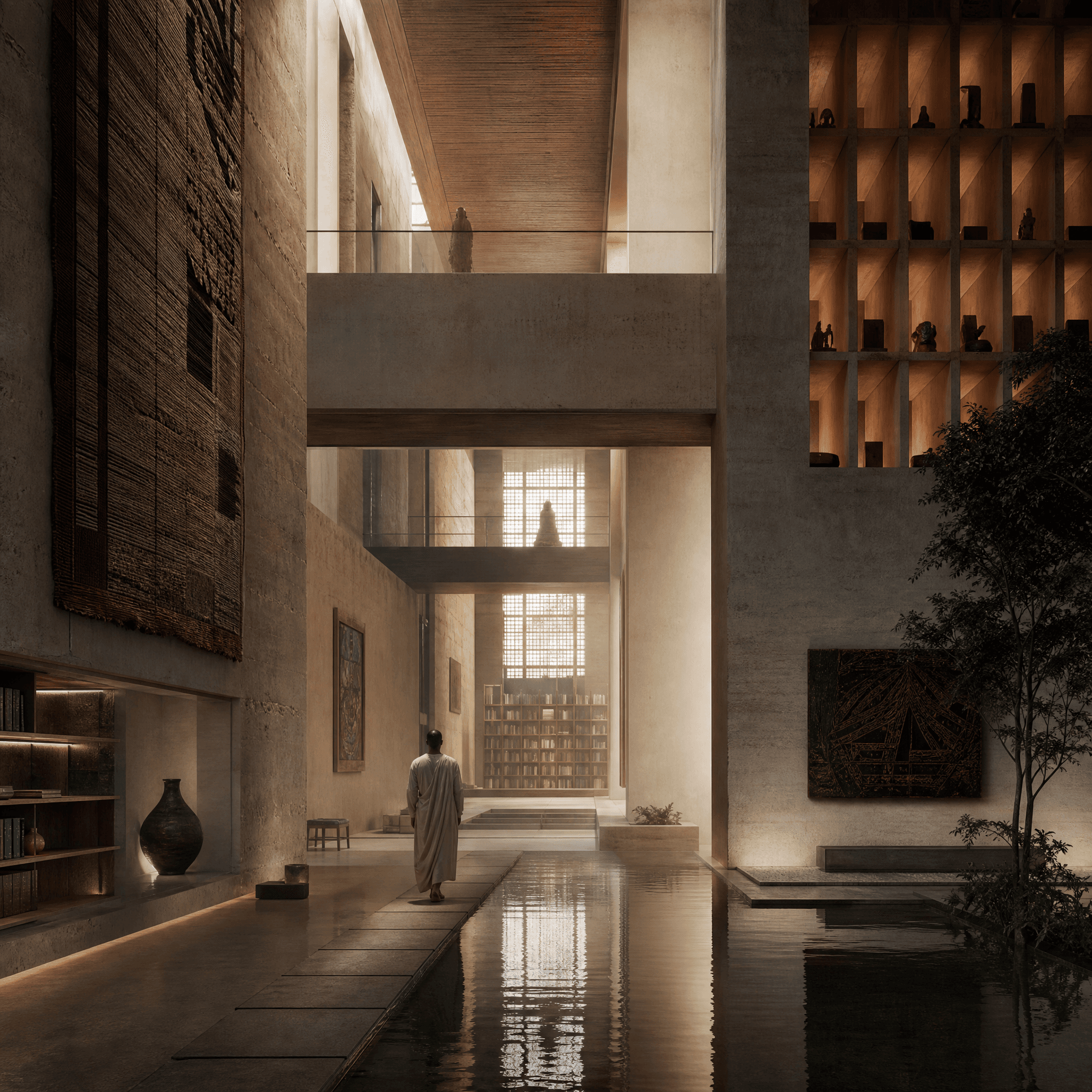
Spatial Intelligence: How the Built Environment Shapes Cognitive and Cultural Experience
The spaces we inhabit are not neutral containers. They are active participants in the formation of thought, behaviour, memory, and identity. Understanding this is the foundation of spatially intelligent design.
Space as Active Agent
Architecture has long understood itself as a service. The architect receives a brief, interprets a set of requirements, and translates them into a building. The building serves its users. This is a functional understanding of design — and it is correct, as far as it goes.
But it is incomplete.
The spaces we inhabit do not simply respond to us. They act on us. They shape how we think, how we feel, how we relate to one another, and how we understand ourselves in relation to the world. The cognitive sciences, environmental psychology, and decades of post-occupancy research have confirmed what architects have always suspected: that spatial quality has measurable, lasting effects on human experience.
This is not an abstract proposition. It has direct consequences for how buildings should be briefed, designed, and evaluated.
The Science of Spatial Experience
Neuroscience and environmental psychology have begun to map the mechanisms by which architectural space influences cognition. Several findings are particularly relevant to the design of residential, cultural, and institutional environments.
Spatial scale and cognitive load. Spaces proportionally suited to their intended activity reduce cognitive effort. Ceiling heights matched to function — higher for creative and social activities, lower for focused individual work — influence both performance and satisfaction in measurable ways.
Light and circadian alignment. The relationship between natural light, its quality, its directional change through the day, is not simply aesthetic. It governs biological rhythms, affects mood regulation, and shapes the experience of time. Buildings that ignore this relationship impose a hidden cost on their occupants.
Sequence and threshold. The experience of moving through a building — the transitions between outside and inside, between public and private, between spaces of different character — is itself a form of communication. How a building is entered, how spaces connect, and how thresholds are defined shapes the psychological relationship between the occupant and the environment.
A building is not experienced as a single moment. It is experienced as a sequence of events, each one inflecting the meaning of the next.
Cultural Infrastructure as Spatial Intelligence
Cultural institutions — museums, libraries, galleries, civic buildings, schools — occupy a particular position in this framework. They are spaces in which the purpose of spatial quality is not merely comfort or efficiency, but the creation of conditions in which a specific kind of human experience becomes possible.
The gallery that organises its spaces to create moments of pause, proximity, and reflection is not simply hanging pictures on walls. It is constructing a context in which art can be encountered on terms that allow it to matter. The library that gives its readers access to natural light, acoustic separation, and spatial variety is not simply storing books. It is creating conditions in which reading, thinking, and inquiry can occur at their fullest intensity.
These distinctions matter because they change what it means to design such buildings well. The brief for a cultural institution is not satisfied by meeting the functional requirements of its programme. It is satisfied when the spatial experience it creates is aligned with the cultural experience its community needs.
Residential Space and the Architecture of Everyday Life
In residential architecture, spatial intelligence operates differently — more intimately, more persistently. The home is the environment in which the greatest portion of human life unfolds. Its spatial quality is not experienced as a visit or an event. It is experienced as a continuous condition.
This means that the quality of light in a kitchen, the acoustic relationship between a living room and a bedroom, the proportional generosity or compression of a hallway, the threshold between a garden and an interior — these are not details. They are the substance of daily experience. They accumulate, over time, into something that either supports or undermines the life lived within them.
The most significant architecture is not the landmark. It is the quiet environment that makes ordinary life better.
The highest-performing residential projects Studio RDN-X has worked on share a common characteristic: they were designed with a clear understanding of how the occupants would actually inhabit the space — not just how they would use it functionally, but how they would experience it over time.
Towards a Spatially Intelligent Practice
Spatial intelligence, as a design principle, begins with a question that precedes the technical brief: what kind of experience should this space create?
Not what should it contain. Not how large it should be. Not what it should look like. But what quality of human experience — cognitive, emotional, social, cultural — it should make possible.
This question is difficult. It requires analysis that draws on research, observation, and cultural understanding as much as technical expertise. It requires an understanding of the people who will use a space that goes beyond schedules and areas. And it requires the discipline to hold that question at the centre of every design decision, even when the practical pressures of a project push towards simpler answers.
At Studio RDN-X, spatial intelligence is not a quality we seek to add to projects. It is the foundation on which all design thinking is built — the question from which every drawing, every decision, and every detail ultimately follows.