The Case for Stage 0: Why Strategic Definition Comes Before Design
Before a single drawing is made, before planning applications are submitted — there is a phase of thinking that most projects skip entirely. This is where projects are won or lost.
The Phase That Changes Everything
Most architecture projects begin in the wrong place. A client arrives with a brief — sometimes a detailed document, sometimes a few sentences — and the design process begins. Drawings are made. Planning applications are submitted. Contractors are appointed.
Then something goes wrong.
Not always dramatically. Sometimes it is a slow erosion: a project that takes longer than expected, costs more than budgeted, or delivers a result that functions but never quite achieves what the client originally imagined. The building exists. It works. But the original ambition — the thing that made the project worth undertaking — is somehow absent from the finished work.
The problem, in almost every case, begins before the first drawing.
What Stage 0 Actually Is
Stage 0 — Strategic Definition — is the first stage of the RIBA Plan of Work. In formal terms, it exists to identify the client's business case, establish the project's strategic objectives, and confirm that design and construction is the right response to achieving them.
In practice, it is much more than that.
It is the phase in which a project finds its genuine purpose. During Stage 0, the fundamental questions are asked: not just what should be built, but why. Not just how large a space should be, but what relationship it should create between the people who use it and the activities it supports. Not just what the planning system will permit, but what the site or building is genuinely capable of.
These are not design questions. They are strategic ones. And they require a different kind of thinking.
The most expensive mistake in architecture is building the wrong thing well.
The Cost of Skipping It
Projects that bypass Stage 0 do not begin design earlier. They begin guessing earlier. And the later in the process an assumption is identified as wrong, the more expensive it becomes to correct.
A misaligned brief discovered at Stage 2 (Concept Design) costs weeks. The same misalignment discovered at Stage 4 (Technical Design) costs months and significant professional fees. Discovered during construction, it can cost a project its budget, its programme, and in some cases its viability altogether.
The RIBA estimates that every pound invested in the pre-design stages of a project can save between five and twenty pounds in downstream design and construction costs. Stage 0 is not a luxury. It is a form of insurance — one that pays out before anything goes wrong.
What Good Stage 0 Work Looks Like
A well-executed Stage 0 process will typically produce:
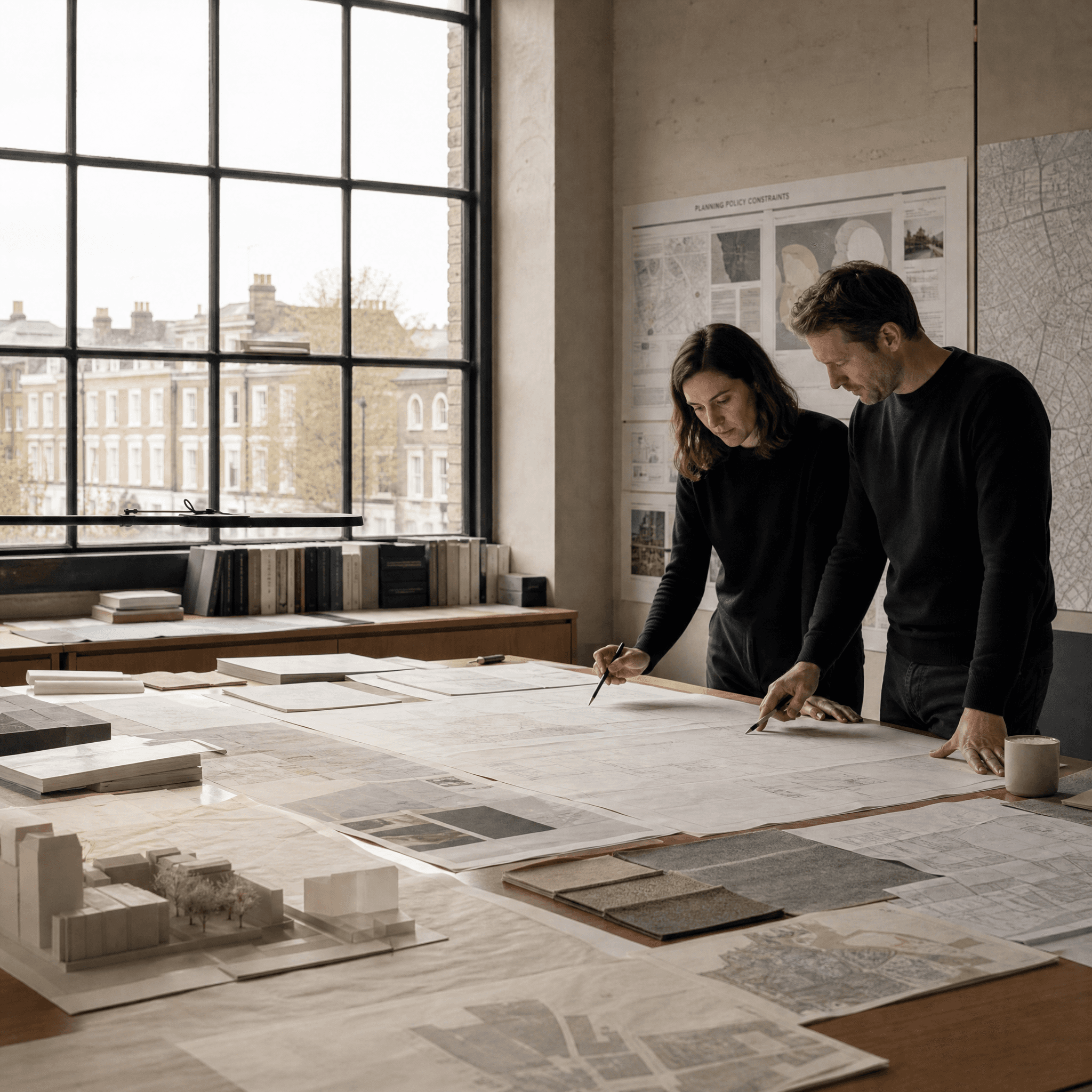
Spatial and planning analysis. An honest assessment of what the site, building, or brief will actually support — accounting for planning policy, structural constraints, neighbour relationships, and the real capabilities of the space.
Strategic brief development. A refined version of the client's requirements that goes beyond room schedules and areas to address the purpose, performance, and long-term use of the project.
Opportunity mapping. An identification of where value can be added, where risks exist, and where unconventional approaches might unlock outcomes that a conventional brief would miss.
Decision framework. A clear set of priorities that can guide the design process through its inevitable moments of compromise — so that when choices have to be made, they are made against a shared understanding of what matters most.
Why It Matters More Now
The context in which architecture is practised has changed. Planning systems are more complex. Construction costs have increased sharply. Client expectations have evolved. The projects that succeed today are those that begin with the clearest possible understanding of what they are trying to achieve and why.
Stage 0 is not new. But its importance is greater than ever.
The most important work of an architect is not visible in the finished building. It is the thinking that makes the right building possible.
At Studio RDN-X, Stage 0 is not a preliminary checkbox before design begins. It is the foundation on which every subsequent decision is made. It is where we ask the hardest questions, establish the most honest assessment of what a project can achieve, and create the strategic clarity that makes everything that follows both more efficient and more meaningful.
Because the measure of a project is not whether it was built. It is whether the right thing was built.