
AUREON RETROFIT FRAMEWORK — UK HOUSING RESEARCH
A research-led framework for regenerating existing homes across the UK through integrated environmental systems, passive design and human-centred retrofit.
29 MILLION
Homes needing retrofit to meet Net Zero targets
15%
Of UK greenhouse gas emissions from housing
Pre-1980
When 60% of UK housing stock was built
EPC C
Government target for all UK homes by 2035
RESEARCH POSITION
A systems-level framework for the retrofit of existing housing. Not a product. Not a commercial offering. A research platform in active development — open to collaboration with housing providers, engineers, policymakers and communities.
The conventional approach to retrofit treats buildings as a list of components to upgrade. Insulate the loft. Replace the boiler. Install solar panels. These interventions are necessary. They are not sufficient.
A home is an environmental system. Fabric, ventilation, moisture, thermal mass, daylight and the occupant's lived experience of warmth, air quality and spatial comfort are all interconnected. An intervention in one affects the others. AUREON Retrofit proposes a methodology that addresses these interdependencies — treating the retrofit process as a discipline of environmental systems integration, not a sequence of isolated upgrades.
The framework draws on passive design principles, environmental engineering, building science, public health research and the emerging evidence base on the relationship between built environments and human wellbeing. It is designed to be adaptable to the full diversity of UK housing stock — from Victorian terraces to high-rise social housing — and scalable from individual homes to neighbourhood-level programmes.
An ageing
stock in an
unstable climate.
The UK has one of the oldest, least energy-efficient housing stocks in Europe. Millions of homes were built before modern thermal performance standards existed, and the overwhelming majority will still be standing in 2050. The scale of the retrofit challenge is without precedent — and the systems for delivering it at speed, quality and equity are not yet in place.
29M
Homes to retrofit
UK homes that need significant energy performance improvements to reach Net Zero targets
60%
Built pre-1980
Of UK housing stock was constructed before modern insulation and thermal performance standards existed
£1.4bn
NHS cost annually
Estimated annual cost to the NHS of conditions caused by cold, damp and poorly performing homes
Only 4%
Are EPC A or B
Of UK homes currently meet the EPC A or B rating — the benchmark for a genuinely energy-efficient home
1 in 10
Have serious damp
Of English homes have a significant dampness problem, contributing to respiratory illness and poor health outcomes
2050
Net Zero target
The UK government's legally binding deadline for achieving Net Zero carbon emissions — requiring unprecedented retrofit delivery at scale
Solid and cavity wall construction, inadequate loft and floor insulation, poorly performing windows — the foundations of the UK's heat loss problem. Fabric-first retrofit remains the highest-priority, highest-impact intervention.
A persistent consequence of cold surfaces, inadequate ventilation and poor airtightness. Increasingly understood as both a housing quality failure and a public health emergency. The Awaab Ishak case brought the scale of the problem into sharp national focus.
A growing risk as UK summers intensify under climate change. Poorly insulated and poorly ventilated homes that lose heat in winter gain it rapidly in summer. Passive cooling strategies are an essential component of any future-proof retrofit.
Poorly ventilated homes accumulate CO₂, moisture, particulate matter, VOCs and other pollutants. The drive towards airtightness creates new risks if ventilation strategy is not addressed simultaneously. Most retrofit programmes address one without the other.
Approximately 13% of English households — around 3 million homes — are in fuel poverty. Poorly performing homes impose disproportionate costs on the households least able to bear them. Retrofit is an economic justice issue as much as an environmental one.
Retrofit funding in the UK has been characterised by short-term programmes, inconsistent standards and delivery capacity constraints. AUREON Retrofit is designed to provide a research foundation that can inform better policy design, procurement and delivery frameworks.
Eight layers.
One integrated
system.
The AUREON Retrofit Framework organises intervention across eight interdependent system layers. Each layer addresses a specific dimension of building performance or occupant experience. None can be considered in isolation — the design of each informs, constrains and enables the others.
Fabric Upgrade
The thermal envelope is the foundation of effective retrofit. Wall, roof and floor insulation; window and door replacement; and airtightness improvement form the irreducible starting point. Systems added before fabric is addressed will consistently underperform.
Ventilation & Air Quality
Improved airtightness creates new ventilation risks that must be managed by design. Mechanical ventilation with heat recovery (MVHR), passive stack ventilation and filtered fresh air supply are selected and integrated based on building typology, occupancy and fabric performance.
Water Intelligence
Water efficiency is an increasingly critical dimension of building environmental performance. Rainwater harvesting, grey water recycling and low-flow fixtures reduce consumption and infrastructure demand, while rainwater management strategies address increasing flood and drainage pressures.
Thermal Comfort
Thermal comfort is not simply a function of air temperature. Surface temperatures, radiant heat, relative humidity and air movement all shape how occupants experience the thermal environment. Cold bridging elimination and thermal mass utilisation are as important as heating system selection.
Passive Cooling
As UK summer temperatures intensify, homes that lose heat poorly in winter gain it rapidly in summer. External shading, cross-ventilation pathways, night purge ventilation and vegetation-based cooling are designed into the retrofit from the outset — not retrofitted to the retrofit.
Environmental Monitoring
Sensor systems tracking CO₂, humidity, temperature, volatile organic compounds and particulate matter provide the performance evidence base for ongoing retrofit decision-making. Real data from real homes is the foundation of an evidence-led retrofit programme.
Low-Carbon Systems
Heat pumps, solar PV, battery storage and smart controls are designed to complement — not substitute for — fabric and passive design improvements. A heat pump in an uninsulated home is an expensive failure. The same system in a well-insulated, well-ventilated home is transformative.
Human Wellbeing
A retrofit that performs well on paper but fails to feel comfortable — stuffy, dark, acoustically exposed or materially poor — is not a successful outcome. Biophilic design elements, daylight optimisation, acoustic performance and sensory material quality are integral to the framework, not optional additions.
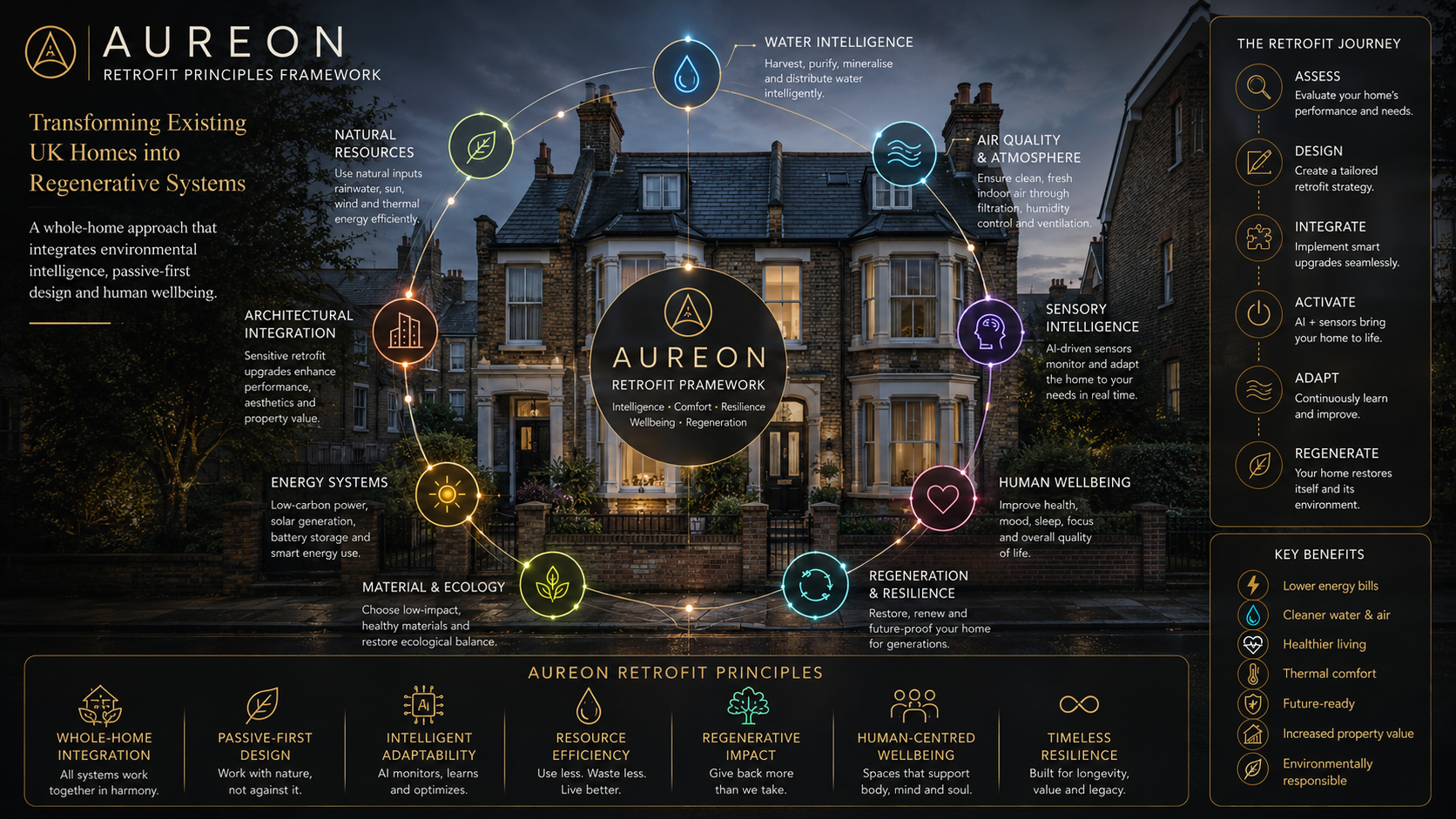
AUREON RETROFIT FRAMEWORK — WHOLE-HOME SYSTEMS INTEGRATION, RETROFIT JOURNEY & KEY PRINCIPLES
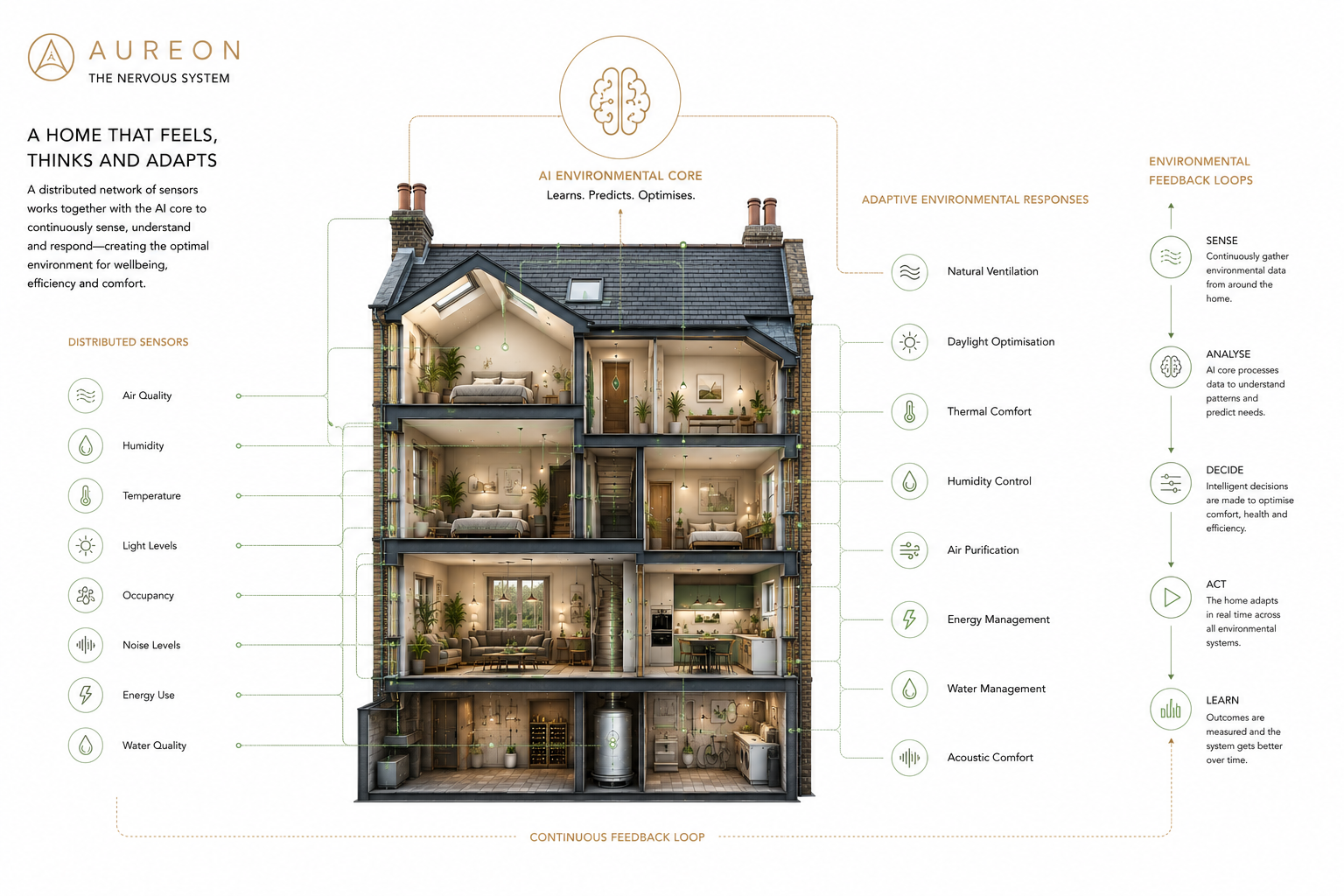
AUREON NERVOUS SYSTEM — DISTRIBUTED SENSING · AI CORE · ADAPTIVE ENVIRONMENTAL RESPONSE · CONTINUOUS FEEDBACK LOOP
Every type
of home.
The AUREON Retrofit Framework has been developed for the full diversity of UK housing stock — from Victorian terraces to high-rise social housing blocks. Each typology presents specific construction challenges, performance deficits and retrofit opportunities.
01
Victorian & Edwardian Terraced
Solid wall construction — the hardest and most common retrofit challenge in UK cities.
Solid brick walls with no cavity for insulation; damp and cold bridging at party walls; limited opportunities for external insulation in terraced rows. The most prevalent typology in UK cities and the most technically and logistically complex to retrofit at scale.
02
Inter-war & Post-war Semi-detached
Cavity wall construction with established retrofit pathways — but persistent delivery challenges.
The first UK generation of cavity wall construction. Retrofit pathways are better established than for solid wall, but asbestos risks, fuel poverty concentrations and occupant vulnerability create consistent delivery complexity.
03
Social Housing Estates
System-built, deck-access and traditional estate housing across all tenures.
Includes low-rise traditional estate housing, medium-rise deck-access blocks and 1960s–80s system-built construction. Retrofit at estate scale demands procurement innovation, social value frameworks and meaningful resident engagement.
04
Converted Flats & Subdivisions
Individual ownership, shared systems and complex tenure arrangements.
Houses divided into flats create significant challenges around shared heating systems, individual landlord obligations and the need for collective decision-making. Retrofitting communal systems requires legal as well as technical design.
05
High-rise Retrofit
Post-Grenfell regulatory context; cladding, ventilation and overheating management.
The Grenfell Tower fire created a fundamentally changed regulatory environment for high-rise retrofit. Fire-safe external insulation, compartmentalisation, ventilation design and overheating risk management are all primary design constraints.
06
Rural & Off-grid Housing
Off-gas-grid properties, vernacular construction and agricultural conversions.
Rural homes face unique challenges: dependence on oil boilers, limited public transport access for retrofit contractors, vernacular construction materials that require specialist knowledge, and communities with limited retrofit support infrastructure.
07
Community & Civic Buildings
Libraries, community centres, places of worship — buildings serving vulnerable populations.
Community buildings often serve the populations most exposed to the health consequences of cold and poor air quality. They are frequently under-resourced, poorly maintained and overlooked by retrofit programmes focused on domestic housing.
How it feels
to live inside.
"The retrofit conversation in the UK has been dominated by energy efficiency metrics and carbon targets. These are necessary. They are not sufficient. A home that performs well on paper but fails to feel comfortable is not a successful outcome."
AUREON Retrofit places occupant experience at the centre of the framework. The seven dimensions of residential wellbeing below are addressed as design outcomes — not afterthoughts — in every retrofit strategy the framework informs.
01
Thermal Comfort
Warmth and coolness where and when needed — across the full seasonal range — without energy waste or uncomfortable variation. Thermal comfort is a function of air temperature, radiant temperature, humidity and air movement, not just heating output.
02
Indoor Air Quality
Fresh, filtered, low-CO₂ indoor air without draughts, odour or humidity extremes. The single most impactful environmental variable for cognitive performance, respiratory health and occupant wellbeing — and the most frequently neglected in retrofit practice.
03
Daylight Quality
Sufficient natural light in living and sleeping spaces, in alignment with circadian rhythm. Daylight affects mood, sleep quality, vitamin D synthesis and perceived spatial quality. Retrofit that compromises existing glazing ratios without mitigation is a measurable health cost.
04
Acoustic Performance
Reduction of external noise intrusion and sound transmission between occupants. Overcrowded, acoustically exposed homes impose consistent psychological and physiological costs — particularly on children, shift workers and those with mental health conditions.
05
Material Sensory Quality
Avoiding chemical off-gassing from adhesives, paints and insulation materials; selecting breathable, natural and low-emission materials where possible. The sensory quality of materials — their texture, smell, acoustic reflectance and tactile temperature — shapes the felt quality of a home.
06
Biophilic Connection
Connection to daylight cycles, seasonal change, outdoor space, planting and natural materials. A substantial and growing evidence base links biophilic residential environments to reduced stress, improved immune function and greater sense of place and belonging.
07
Environmental Dignity
A home that is demonstrably well-cared-for, spatially legible, free from damp and vermin, and comfortable to inhabit is a home that supports the dignity of its occupants. The quality of the residential environment is inseparable from the quality of the life lived within it.
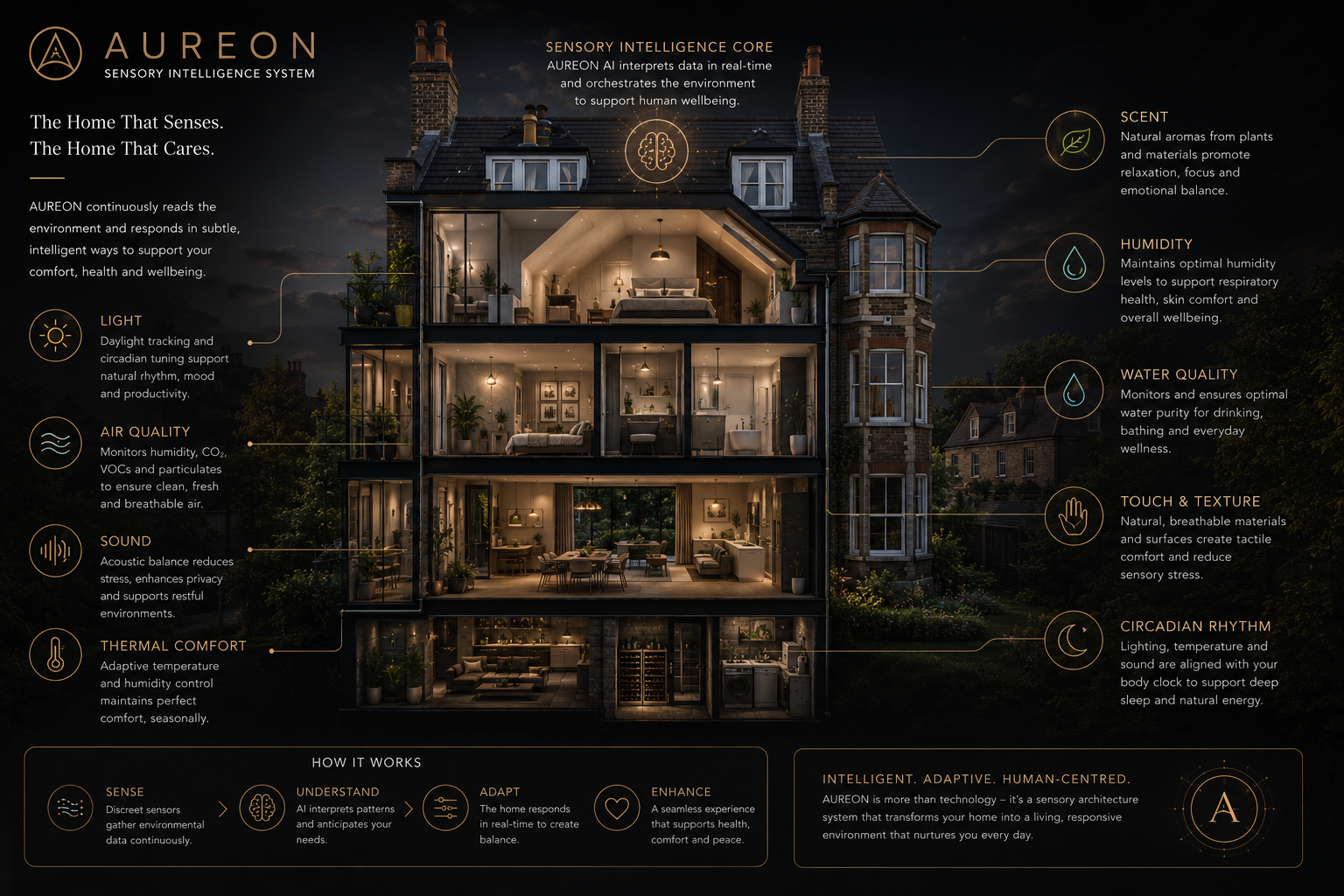
AUREON SENSORY INTELLIGENCE — NINE ENVIRONMENTAL DIMENSIONS APPLIED TO UK HOUSING STOCK
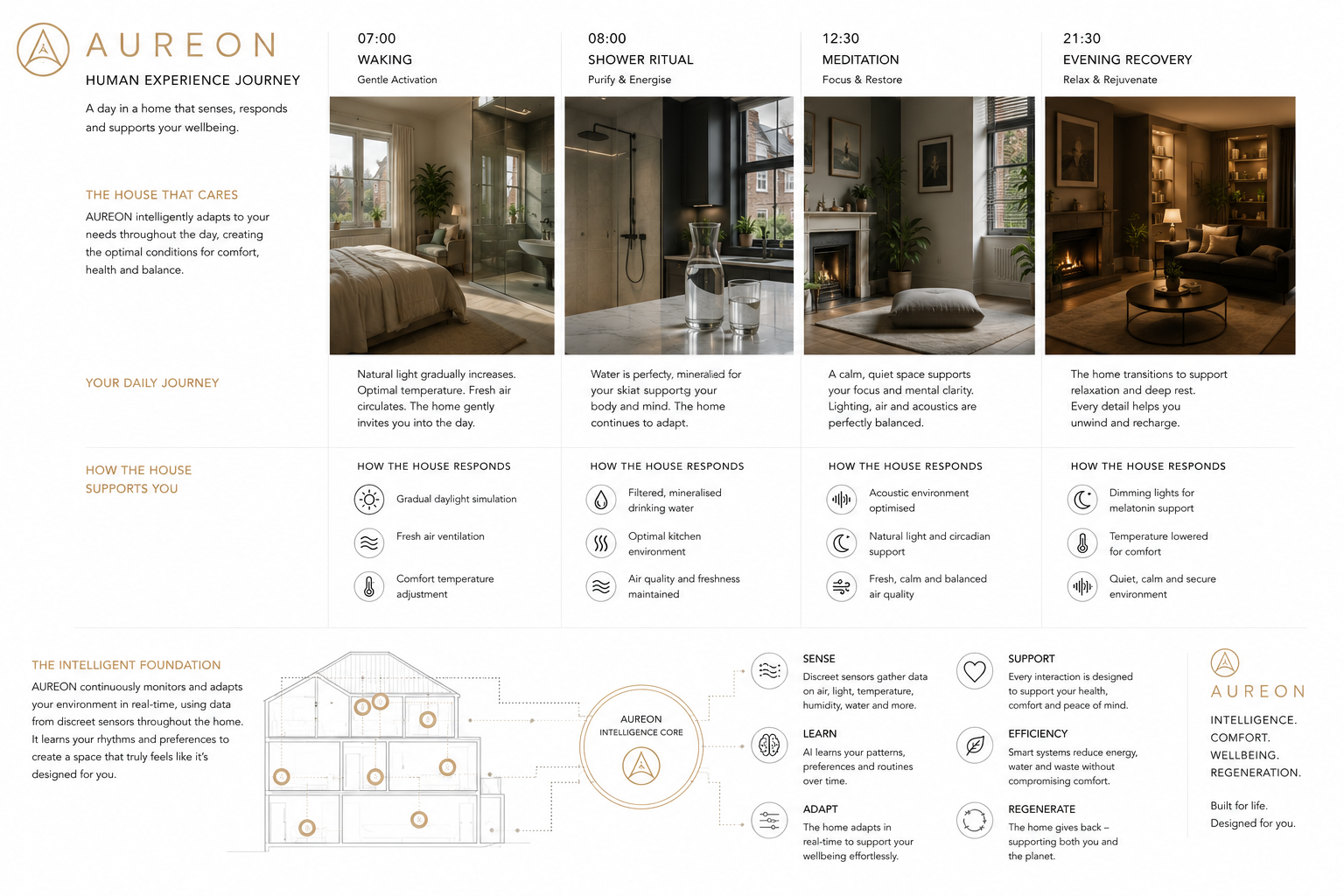
AUREON HUMAN EXPERIENCE JOURNEY — WAKING · SHOWER RITUAL · MEDITATION · EVENING RECOVERY
Built on
evidence.
AUREON Retrofit is an evolving research platform. Studio RDN-X is developing the framework through direct engagement with housing providers, local authorities, environmental engineers and occupants. The research programme below describes the structure of that development.
Who this
is for.
AUREON Retrofit is designed to be deployed in partnership. The framework is intended to inform and support the work of the organisations, institutions and programmes most directly engaged in the retrofit of UK housing.
01
Local Authorities
Councils managing social housing stock, developing local area energy plans and delivering place-based retrofit programmes under the UK's decarbonisation obligations. AUREON Retrofit provides a design methodology that can sit alongside existing procurement and delivery frameworks.
02
Housing Associations
Registered providers with retrofit obligations under the Social Housing Decarbonisation Fund, Decent Homes Standard and EPC improvement targets. The framework provides a systems-level approach that supports better quality outcomes from capital retrofit programmes.
03
Retrofit Funding Programmes
The UK Government's Home Upgrade Grant, ECO4, Social Housing Decarbonisation Fund and emerging local green finance instruments. AUREON Retrofit is designed to be compatible with existing funding structures while advocating for methodology standards that improve programme outcomes.
04
Universities & Research Institutions
Architecture, environmental engineering, public health and housing policy research groups. Studio RDN-X is seeking formal research partnerships to develop the evidence base, methodology and monitoring protocols underpinning the AUREON Retrofit Framework.
05
Net Zero & Decarbonisation Programmes
Local area energy plans, combined authority decarbonisation strategies and place-based Net Zero programmes. The AUREON Retrofit Framework is designed to contribute a design quality and wellbeing dimension to programmes primarily oriented around carbon and energy metrics.
06
Regenerative Urbanism & Social Value
Organisations working at the intersection of housing, community resilience, ecological performance and social value. Retrofit is a neighbourhood-scale intervention as much as a building-scale one — AUREON Retrofit is designed to contribute to place-based approaches that integrate environmental and social outcomes.
The homes
already exist.
The work begins
inside them.
Studio RDN-X is an interdisciplinary architecture and research studio developing the systems, methodologies and spatial intelligence needed to address one of the defining challenges of the built environment: how to transform the UK's existing housing stock into homes that perform well, feel good to inhabit, and contribute positively to the ecological and social fabric of their communities.
AUREON Retrofit is one part of that commitment. The framework is in active development. We are looking for housing providers, engineers, policy researchers and communities who want to think carefully about what retrofit can be — not just what it must deliver.
RESEARCH NOTE
AUREON Retrofit Framework is a speculative research initiative developed by Studio RDN-X. All framework documentation, methodological content and research findings are the intellectual property of Studio RDN-X. The framework is in active development and does not represent a completed methodology, a commercial product or a guarantee of outcomes. Collaborators and partners are engaged on a case-by-case basis.